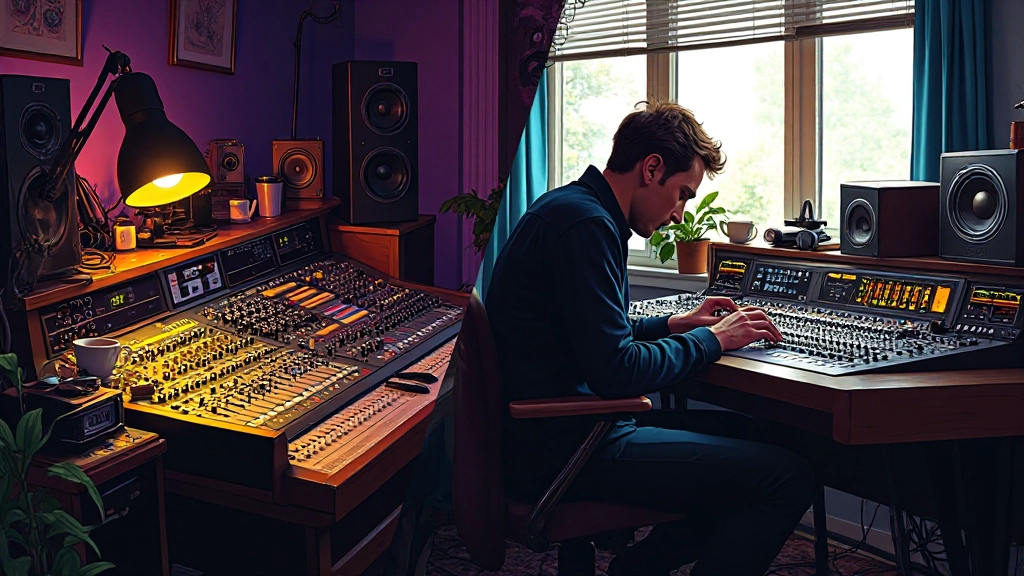
It's 2:47 AM and your latest mix sounds absolutely pristine through your headphones. The vocal sits perfectly, the kick punches without overpowering, and that guitar solo finally has the shimmer you've been chasing. You bounce the track with confidence, upload it to your collaborators, and drift off to sleep feeling like you've cracked the code. Then noon hits.
You press play with your morning coffee, and it's like listening to someone else's work. The vocal sounds buried, the low end is either completely missing or completely overwhelming, and that "perfect" guitar tone now sounds like it's wrapped in blankets. Sound familiar?
Last month, I was working with Trevor, a singer-songwriter from Portland who'd been wrestling with this exact phenomenon for months. He'd send me mixes that were clearly crafted by someone who knew what they were doing, but they all had the telltale signs of late-night mixing syndrome. Every track suffered from the same pattern: overcompensated highs, scooped midrange, and bass decisions that made sense only to ears that had been listening for six hours straight.
The Biology Behind Midnight Magic
Your ears aren't the same at midnight as they are at noon. This isn't just about being tired, although fatigue plays a major role. Your hearing sensitivity actually shifts throughout the day due to several physiological factors that most home studio owners never consider.
First, there's the Fletcher-Munson effect, which describes how our perception of frequency balance changes with volume. But there's another layer: your ears become less sensitive to certain frequencies after extended listening sessions. This temporary threshold shift explains why that snare that sounded perfect at 1 AM suddenly sounds paper-thin when you listen back the next afternoon.
Trevor's breakthrough came when we mapped out his listening patterns. He consistently mixed between 10 PM and 3 AM, always pushing through ear fatigue because "that's when the creativity hits." But creativity and critical listening are two different skills that require different approaches.
Reading the Warning Signs in Your Mix Sessions
The first step in breaking the midnight-to-noon cycle is recognizing when your ears are lying to you. There are specific warning signs that appear long before you realize you're in trouble.
Watch for the volume creep. If you started your session at a comfortable monitoring level and now find yourself gradually turning up to hear detail, your ears are already compromised. Professional mixers call this "chasing the level," and it's the fastest way to destroy your frequency perception.
Monitor your EQ moves. Are you making increasingly dramatic boosts in the high end? Do you keep adding more and more low-mid cut to "clean up" the mix? These are classic compensation moves for tired ears. Fresh ears would hear these adjustments as harsh and thin.
- Set a reference level at the start of your session and stick to it
- Take mandatory 15-minute breaks every hour away from the studio
- Use a reference track every 30 minutes, not just at the end
- Save multiple versions with different EQ approaches
- Stop making major frequency decisions after 2 hours of continuous listening
The Three-Listen Test That Saves Your Mix
Here's the system that transformed Trevor's workflow and has since become standard practice in my own mixing sessions. It's deceptively simple but requires discipline to implement consistently.
First, do your initial mix pass when your ears are fresh. This means within the first hour of your session, before you've listened to anything else that day. Make your broad strokes here: relative levels, basic panning, and rough EQ moves. Don't chase perfection.
Second, take a real break. Not a "scroll through your phone while the song loops" break, but an actual departure from the studio environment. Go outside, have a conversation, let your ears reset for at least 20 minutes.
Third, return for your detail pass. This is where you make surgical EQ moves, set compression ratios, and fine-tune effects. But here's the crucial part: resist the urge to undo everything you did in the first pass. If something sounds dramatically different, trust your initial instincts over your current perception.
"The mix you hear after a break isn't necessarily more accurate than the one you heard before. But the difference between them tells you everything about the state of your ears."
Why Your Room Sounds Different After Dark
It's not just your ears that change after sunset. Your physical environment shifts in ways that directly impact how you perceive your mix, and most home studio owners are completely unaware of these changes.
Temperature affects both your equipment and your hearing. As your room cools down in the evening, speakers can sound slightly warmer due to changes in component behavior. Meanwhile, your ears become marginally less sensitive to high frequencies in cooler temperatures. These small shifts compound over a long session.
But the bigger issue is ambient noise. That gentle hum of traffic, air conditioning, or neighbor activity that your brain filters out during the day? It creates a subtle masking effect that changes your perception of low-level details. When those sounds disappear late at night, suddenly your mix environment has effectively become quieter, making you perceive more detail and often leading to overcorrection.
| Time Factor | Impact on Perception | Common Mix Error |
|---|---|---|
| Late Night Silence | Increased detail perception | Over-compression of quiet elements |
| Temperature Drop | Speaker warmth increase | Excessive high-frequency boosting |
| Extended Listening | 3-6kHz sensitivity loss | Vocal harshness from overcompensation |
| Fatigue Onset | Bass perception shifts | Low-end decisions that don't translate |
Building Better Listening Habits for Consistent Results
The solution isn't to stop mixing at night. Some of us do our best creative work after dark, and fighting your natural rhythm rarely leads to better music. Instead, it's about developing habits that work with your biology rather than against it.
Start every session with the same reference track at the same volume level. This creates a consistent baseline for your ears and helps you recognize when your perception starts to drift. Choose something you know intimately, preferably in a similar genre to what you're mixing.
Implement what I call "checkpoint saves." Every 45 minutes, save a new version of your mix with a timestamp. Don't just save the project file; bounce a quick stereo mix. This gives you multiple snapshots to compare when you return with fresh ears.
Use visual references alongside your ears. A spectrum analyzer won't tell you if your mix sounds good, but it will tell you if you're making the same frequency mistakes you made in previous late-night sessions. Look for patterns in your EQ moves across multiple projects.
- Set up your monitoring environment before you start mixing, not during
- Use the same reference track and level for the first month of implementing this system
- Make note of what time you start hearing things differently (this varies by person)
- Always bounce a mix before your "detail pass" begins
- Schedule specific times for major mix decisions when your ears are fresh
When to Trust Your Tired Ears (And When Not To)
Not every late-night mix decision is wrong. Tired ears often hear musical aspects that fresh, analytical ears miss. The emotional flow of a song, the way reverb tails decay into silence, the subtle interplay between elements, these musical qualities often become more apparent when your critical faculties are slightly relaxed.
Trevor learned to separate technical decisions from musical ones. Late-night sessions became his time for creative effects processing, automation moves that enhanced the song's emotional arc, and overall vibe adjustments. The next morning, with fresh ears, he'd tackle frequency balance, compression settings, and stereo imaging.
This division of labor actually improved both aspects of his mixes. His creative choices had more flow and musicality because he wasn't second-guessing every artistic decision through an analytical filter. His technical choices were more accurate because he wasn't making them with compromised hearing.
The Next-Day Listen: What to Fix and What to Keep
When you return to yesterday's mix with fresh ears, you'll likely hear several things that make you want to start over. Resist this urge. Instead, categorize what you're hearing into three buckets: obvious problems, questionable choices, and elements that still sound good.
Obvious problems are things like harsh frequencies, muddy low-mids, or buried vocals. Fix these immediately. Your tired ears genuinely missed these issues, and they'll be obvious to listeners too.
Questionable choices require more careful evaluation. Maybe that reverb sounds like too much, or the vocal seems slightly too bright. Before changing anything, listen to your reference track again. Often, what sounds like "too much" to your fresh ears is actually just "different from what you usually do."
Elements that still sound good should be left alone, even if you can't remember why you made certain choices. This is where tired ears sometimes make musical decisions that analytical ears would overthink.
Trevor's workflow now includes a "24-hour rule" for major changes. If something bothers him during the next-day listen, he makes a note but doesn't fix it immediately. Instead, he listens again 24 hours later. About half the time, the issue that seemed obvious with fresh ears turns out to be perfectly fine after another day of perspective.
Reference Tracks That Actually Work for Ear Calibration
Most mixing advice tells you to use reference tracks, but few sources explain how to use them effectively for managing ear fatigue and perception drift. The key is choosing references that reveal specific problems rather than general "vibe" comparisons.
Select one track that has excellent vocal presence without harshness. This becomes your guide for the 3-6 kHz range where tired ears make the most mistakes. When you think your vocal sounds perfect, play this reference. If your vocal suddenly sounds dull or harsh by comparison, you'll know your ears have drifted.
Choose another reference for low-end balance. Pick something with clear kick definition and controlled bass that doesn't overwhelm other elements. This is crucial for late-night mixing when bass perception becomes unreliable.
Finally, find a reference with good overall dynamics. Something that breathes naturally without feeling compressed or lifeless. This helps you recognize when you're overcompressing due to fatigue-induced detail chasing.
Making Peace with Imperfect Timing
After six months of implementing these changes, Trevor's mixes improved dramatically. But more importantly, he stopped fighting his natural creative rhythm. He still does his most inspired work after 10 PM, but now he has systems in place to capture that creativity without sacrificing technical quality.
The goal isn't to mix with perfect ears all the time. It's to understand what your ears are doing at different times and stages of fatigue, then build workflows that account for these changes. Some of my favorite mixes have come from sessions that started at midnight and ended at dawn, but they were saved by next-day technical passes that corrected for the known biases of tired ears.
Your ears will always change throughout a session. The question is whether you'll work with that change or against it. Understanding the midnight-to-noon cycle isn't about becoming a more robotic mixer; it's about becoming a more aware one.
Hear what these choices do to your own song.
Upload stems or a finished track, choose a reference direction, and compare a private Moozix mix before you export anything.