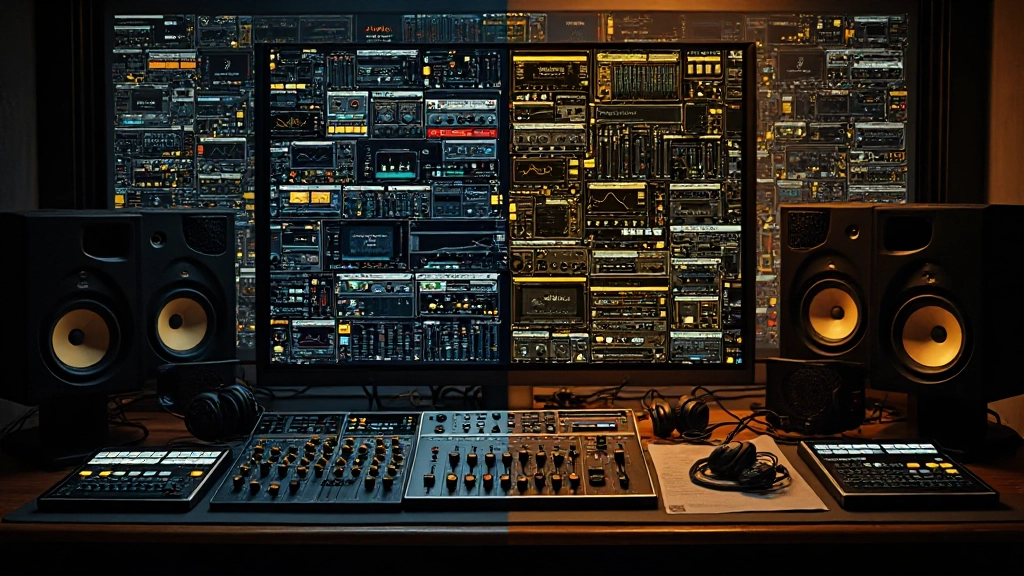
The mix was drowning in its own processing. Every channel loaded with four, five, sometimes six plugins, each doing what the engineer thought was helping. But Craig sat there, listening to the playback through the studio monitors, knowing something fundamental was wrong.
"More isn't always better," he muttered, reaching for the bypass buttons. One by one, he started shutting off processors, and with each click, the mix began to breathe again. The kick drum found its punch, the vocal stepped forward, and suddenly the song made sense.
This scene plays out in home studios and professional facilities alike. The tools meant to enhance our mixes often become the very obstacles preventing them from reaching their potential. Let's examine five persistent myths about processing that keep engineers trapped in plugin overload, and explore the minimalist mindset that actually delivers professional results.
Myth #1: Every Channel Needs EQ
Walk into most home studios during a mixing session, and you'll see it immediately. Every single track has an EQ plugin inserted, whether it needs one or not. The assumption runs so deep that many engineers automatically load their "starter template" with EQs on every channel before they've even heard the raw recording.
The reality? Some of the most powerful mixes in modern music feature tracks that have never been touched by equalization.
Consider this: when Grammy-winning engineer Amanda Rodriguez tracks acoustic guitars in her Nashville facility, she spends considerable time finding the right microphone position and preamp combination. "If I've done my job correctly during recording," she explains, "that acoustic guitar track might not need any EQ at all. The moment I start cutting and boosting, I'm admitting that something went wrong earlier in the process."
This approach fundamentally changes how you listen. Instead of immediately reaching for the high shelf to add "air" or cutting the low-mids because you read somewhere that 200Hz is always muddy, you focus on what the recording actually sounds like in context.
Try this exercise: load your current mix project and bypass every EQ plugin. Listen to the raw balance. Notice which elements truly clash and which simply need better level relationships. You might discover that your carefully crafted EQ curves were actually working against the natural character of your recordings.
Myth #2: Compression on Everything Equals Professional Sound
The compressor myth runs even deeper than the EQ obsession. Somewhere along the way, the home recording community developed the belief that professional mixes compress every element to achieve that "polished" sound. This misconception leads to mixes where every transient has been squashed, every dynamic nuance eliminated, and every element fighting for space in an overly controlled sonic landscape.
Danny Kim, a mixing engineer who's worked with major-label artists across multiple genres, puts it bluntly: "The best compressor setting is often no compressor at all. I've received mixes where every single track was compressed to death, and my first job was to find the original recordings and start over."
Consider the role dynamics play in musical storytelling. When every element maintains the same compressed character throughout the song, you lose the natural ebb and flow that keeps listeners engaged. The whispered verse that builds to the explosive chorus becomes impossible when everything sits at the same dynamic level.
| Element | When Compression Helps | When to Skip It |
|---|---|---|
| Vocals | Controlling inconsistent performance levels | Already consistent delivery, good mic technique |
| Drums | Adding punch to weak-sounding hits | Well-recorded acoustic kit with natural dynamics |
| Bass | Evening out fingerstyle inconsistencies | Solid pick technique, consistent attack |
| Guitars | Controlling amp distortion levels | Clean tones, controlled playing dynamics |
The key insight here involves understanding what compression actually accomplishes versus what many engineers think it does. Compression controls dynamics, not necessarily loudness or impact. Sometimes the most powerful sound comes from preserving the natural dynamic range of your performance.
Myth #3: Digital Reverb Chains Create Expensive-Sounding Space
Nothing identifies amateur mixing faster than the "reverb soup" approach. Multiple reverb plugins on individual tracks, each with different decay times, different room simulations, different pre-delay settings, all swimming together in a muddy mess that destroys rather than enhances the spatial characteristics of the mix.
Professional mixing typically uses reverb much more strategically. Instead of loading up individual tracks with their own spatial processors, experienced engineers create deliberate reverb sends that multiple elements share. This approach builds cohesive space rather than conflicting acoustic environments.
Lisa Park, whose mixing work spans indie rock to major-label pop, describes her reverb philosophy: "I might use just two reverbs for an entire mix. One shorter room sound for drums and guitars, one longer hall for vocals and special moments. The goal is to place everything in the same believable space, not create seventeen different rooms that somehow exist simultaneously."
- Set up two auxiliary sends: One for short room ambience (0.8-1.5 seconds), one for longer, more dramatic space (2.5-4 seconds)
- Route multiple elements to the same send: Drums and guitars often share the room reverb, vocals and lead instruments share the hall reverb
- Use reverb to create depth, not width: Place elements at different distances in the same acoustic space rather than spreading them across different rooms
- High-pass your reverb returns: Remove low-frequency information from reverb sends to prevent muddiness while maintaining the spatial effect
This minimalist approach to spatial processing creates mixes that sound larger and more professional than the plugin-heavy alternatives. When every element exists in a coherent acoustic space, the listener's brain can relax and focus on the musical content rather than trying to process conflicting spatial information.
Myth #4: Saturation Plugins Automatically Add Analog Warmth
The "analog warmth" myth might be the most expensive misconception in modern mixing. Engineers load up tape saturation, tube saturation, console saturation, and transformer saturation plugins, often multiple types on the same channel, believing that more processing equals more of that coveted vintage character.
But here's what actually happens: excessive saturation processing creates harmonic distortion that competes with the natural harmonic content of your musical performances. Instead of enhancing the vintage character, you're often masking the organic qualities that made the recording compelling in the first place.
Professional engineers use saturation much more selectively. Rather than applying it broadly across every channel, they identify specific elements that benefit from harmonic enhancement and apply processing judiciously.
Take vocals, for example. A vocal that was recorded through a high-quality tube preamp already contains natural harmonic complexity. Adding digital saturation on top often creates conflicting harmonic information rather than enhancing the existing character. The result sounds processed rather than warm.
Instead, focus on these strategic saturation applications:
- Vocals: Only when the original recording sounds overly sterile or was tracked through very clean preamps
- Drums: Subtle tape saturation on the drum bus to glue elements together, not individual channel processing
- Bass: Light tube saturation for added harmonic content, but only if the DI signal lacks character
- Mix Bus: Very subtle console saturation for overall cohesion, applied sparingly
Myth #5: AI-Powered Mastering Chains Need Human Enhancement
As artificial intelligence becomes more sophisticated in audio processing, a new myth has emerged: that AI-powered mastering tools produce results that need extensive human "enhancement" through additional plugin chains. This misconception leads engineers to process already-mastered audio through multiple additional stages, often degrading rather than improving the final result.
Modern AI mastering algorithms analyze thousands of reference tracks and apply processing based on comprehensive acoustic analysis. When functioning correctly, these systems often make more accurate spectral balance decisions than human engineers working in untreated rooms with consumer monitors.
The mistake comes in the assumption that more processing always equals better results. Engineers receive AI-mastered tracks, then feel compelled to add their own EQ curves, their own compression, their own limiting stages, effectively double-processing the audio.
"I used to add my own mastering chain on top of AI processing, thinking I was improving things. Then I did A/B comparisons on professional monitors and realized I was just adding artifacts. Sometimes the algorithm got it right the first time."
Mike Petersen, independent producer
The more effective approach involves learning to evaluate AI processing results objectively. Instead of automatically assuming the output needs enhancement, test the masters across multiple playback systems. Often, what sounds "under-processed" on your studio monitors translates perfectly on consumer playback devices.
When AI mastering does require adjustment, focus on single-purpose corrections rather than full reprocessing chains. If the low end needs slight adjustment, use targeted EQ rather than rebuilding the entire master chain. If dynamics need modification, address compression specifically rather than applying broad multiband processing.
Breaking Free from Plugin Dependency
The path toward cleaner, more impactful mixes starts with breaking the psychological dependence on processing. This doesn't mean abandoning plugins entirely, but rather developing the confidence to use them only when they serve a clear musical purpose.
Start with this weekly exercise: choose one completed mix from your catalog and create a "minimal version" using no more than three plugins per track. You might discover that the simplified version actually sounds more powerful than the original processed version.
Professional mixing isn't about having the most plugins or the most complex signal chains. It's about making deliberate decisions that serve the song. Sometimes that means adding processing. Often, it means having the restraint to leave good recordings alone.
The next time you load up your DAW, resist the urge to immediately insert your standard plugin templates. Listen first. Process second. And remember that the most powerful tool in your arsenal isn't a compressor or EQ, but the bypass button that reminds you what actually needs fixing.
Your mixes don't need more processing. They need better decisions. Start making those decisions by questioning every plugin, justifying every setting, and trusting that sometimes the best enhancement is no enhancement at all.
Hear what these choices do to your own song.
Upload stems or a finished track, choose a reference direction, and compare a private Moozix mix before you export anything.