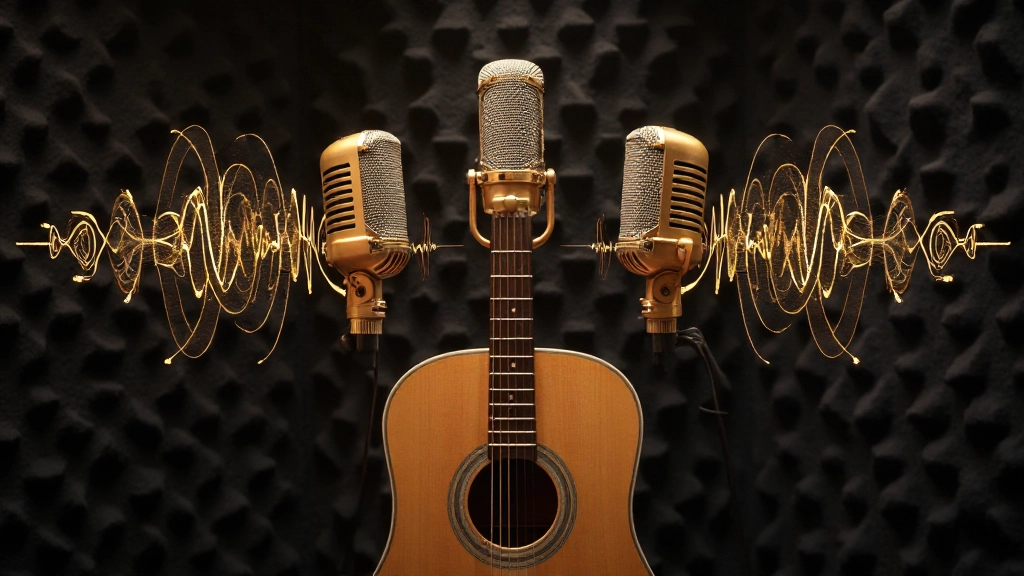
The overhead mics were capturing every nuance of Jerome's fingerpicking, but something was fundamentally wrong. Each time he struck a chord, the low end seemed to disappear, leaving behind a hollow, brittle sound that no amount of EQ could fix.
Three seasoned engineers had worked on this folk album, each adding their own mic to capture different aspects of the performance. The close-up dynamic mic caught the attack and string noise. The small-diaphragm condenser positioned two feet back captured the body resonance. The room mic eight feet away added natural ambience.
Individually, each microphone sounded fantastic. Together, they created a sonic disaster that took two days to unravel. The culprit wasn't the mics, the preamps, or the room acoustics. It was phase alignment, the invisible force that can either strengthen your recordings or systematically destroy them.
Understanding Phase Relationships in Multi-Mic Scenarios
When multiple microphones capture the same sound source, each mic receives the audio at slightly different times based on its distance from the source. A microphone positioned one foot from a guitar receives the sound roughly 1 millisecond before a mic positioned two feet away. This timing difference creates phase relationships that can either reinforce or cancel specific frequencies when the signals are combined.
Phase cancellation occurs when two identical waveforms arrive at opposite phases, effectively erasing each other. Partial phase cancellation creates the characteristic "hollow" or "thin" sound that plagued Jerome's guitar recordings. The fundamental frequencies were being weakened while certain harmonics remained strong, creating an unnatural tonal balance.
The mathematics behind phase relationships might seem complex, but the practical application comes down to careful positioning, timing adjustments, and selective polarity flipping. Professional engineers develop an instinct for spotting phase problems, but the underlying principles can be learned and applied systematically.
The Distance Game: Mic Placement That Minimizes Conflicts
The most effective way to handle phase alignment starts before you hit record. Strategic microphone placement following the "3-to-1 rule" provides a foundation for phase-coherent recordings. This rule states that if one microphone is positioned one foot from the source, the next closest mic should be at least three feet away.
During a particularly challenging drum session, engineer Patricia Wellman faced the task of capturing both the intimate detail of a snare drum and the natural room ambience. She positioned the close mic six inches from the snare rim, capturing the crack and overtones. The room mic was placed eighteen feet away, well beyond the 3-to-1 minimum distance.
| Microphone Position | Distance from Source | Primary Capture | Phase Consideration |
|---|---|---|---|
| Close mic | 6-12 inches | Attack and detail | Reference timing |
| Mid-distance mic | 2-4 feet | Body and resonance | 3x close mic distance |
| Room mic | 8-15 feet | Ambience and space | 3x mid-distance |
The 3-to-1 rule works because it ensures that any phase cancellation occurs at frequencies too high to significantly impact the fundamental character of the source. Low-frequency phase cancellation, which destroys the weight and power of instruments, becomes much less likely when microphones are properly spaced.
However, musical requirements sometimes demand closer mic spacing. When recording a piano with both close and mid-distance mics, the desired intimacy might require positioning that violates the 3-to-1 rule. In these cases, precise timing adjustments become essential.
Time Alignment: Digital Tools for Micro-Adjustments
Modern digital audio workstations provide sample-accurate timing control that allows engineers to align multiple microphone signals precisely. The process involves identifying the same transient event across multiple tracks and adjusting the timing so these events occur simultaneously.
When working with Jerome's guitar recording, the solution came through careful analysis of a sharp fingerpick attack visible across all three microphone tracks. The close mic served as the timing reference, since it received the sound first. The mid-distance mic needed a 2.3 millisecond delay adjustment, while the room mic required 7.1 milliseconds.
- Identify a sharp transient event visible across all microphone tracks
- Zoom in to sample-level resolution in your DAW
- Mark the exact peak of the transient on your reference track
- Measure the timing offset on each additional track
- Apply delay compensation to align all transients precisely
Most professional DAWs include automatic delay compensation features, but manual adjustment often provides superior results for complex multi-mic scenarios. The goal isn't perfect mathematical alignment, but rather the alignment that produces the most musical result when all tracks are combined.
Some engineers prefer to handle timing alignment during mixing rather than recording, maintaining flexibility to experiment with different phase relationships. This approach requires careful track organization and documentation to avoid confusion during later sessions.
Polarity: The Quick Fix That Transforms Problem Signals
Polarity inversion, often called "phase flip," reverses the positive and negative portions of an audio waveform. This simple adjustment can instantly resolve many phase-related problems in multi-mic recordings, transforming weak, hollow sounds into full, powerful signals.
During a recent acoustic guitar session, engineer Bradley Chen faced a familiar problem. Two mics positioned for optimal tonal capture were creating significant low-frequency cancellation. Rather than repositioning the microphones and losing the desired tonal character, he applied polarity inversion to one track.
"The moment I flipped the polarity, the guitar went from sounding like it was recorded through a telephone to having this rich, full-bodied presence that cut through the mix beautifully."
The polarity flip test should be performed systematically across all microphone combinations. With three mics, you'll need to test eight different polarity combinations to find the optimal setting. This might seem excessive, but the sonic differences can be dramatic enough to change the entire character of your recording.
- Test polarity combinations while monitoring in mono
- Listen for low-frequency fullness and mid-range clarity
- Check stereo imaging after finding optimal polarity
- Document polarity settings for future reference
Monitoring in mono during polarity testing reveals phase problems more clearly than stereo listening. Stereo imaging can mask phase cancellation by spreading the problem across the soundfield, making it harder to identify the optimal polarity combination.
Advanced Techniques: EQ and Processing in Phase-Coherent Systems
Once basic phase alignment is achieved, advanced techniques can further optimize multi-mic recordings. Complementary EQ approaches assign different frequency responsibilities to each microphone, reducing the potential for phase-related conflicts while maximizing the unique contribution of each mic.
Engineer Monica Torres developed a systematic approach for three-mic acoustic instrument recordings. The close mic receives high-frequency enhancement to emphasize attack and string detail. The mid-distance mic gets broad midrange support, capturing body resonance without overlap. The room mic handles the low-mid frequencies that provide weight and warmth.
This frequency separation approach reduces phase conflicts because each microphone primarily contributes different portions of the frequency spectrum. When phase cancellation does occur, it affects frequencies that aren't crucial to that particular mic's role in the overall sound.
Compression and other dynamic processing can alter phase relationships, particularly when applied heavily to individual tracks before phase alignment is established. Many engineers prefer to set basic levels and phase relationships before applying detailed processing, maintaining the integrity of their phase corrections.
Troubleshooting Common Multi-Mic Problems
Comb filtering represents one of the most common phase-related problems in multi-mic recordings. This phenomenon creates a series of frequency peaks and nulls that give the audio a hollow, metallic character. Comb filtering typically results from microphones positioned too close together relative to the wavelengths being captured.
The solution often involves either increasing microphone spacing or using time alignment to minimize the comb filtering effect. In some cases, partial use of one microphone signal, achieved through careful level balancing, provides better results than attempting to use both mics at equal levels.
Low-frequency phase cancellation manifests as weak, thin bass response despite using microphones capable of capturing full-range audio. This problem frequently occurs with acoustic guitars, pianos, and other instruments where multiple mics are used to capture both detail and resonance.
| Problem | Symptoms | Primary Solution | Alternative Approach |
|---|---|---|---|
| Comb filtering | Hollow, metallic tone | Increase mic spacing | Time alignment adjustment |
| Low-end cancellation | Thin, weak bass | Polarity inversion | Mic repositioning |
| Stereo imaging collapse | Narrow, mono-like width | Check mono compatibility | Individual mic panning |
| Frequency holes | Missing midrange bands | Complementary EQ | Single mic selection |
Stereo imaging problems in multi-mic recordings often stem from phase relationships that work well in mono but create problems when the signals are panned. Testing your phase-aligned tracks in various stereo configurations helps identify potential imaging issues before they become mix problems.
Building Your Phase Alignment Workflow
Developing a consistent approach to phase alignment streamlines the recording process and ensures reliable results across different sessions and studios. The workflow begins during tracking with strategic mic placement and continues through mixing with precise timing and polarity adjustments.
Professional engineer Derek Liu has refined his multi-mic workflow over fifteen years of recording acoustic instruments. He begins each session with a standard mic placement template based on the 3-to-1 rule, then makes fine adjustments based on the specific instrument and room characteristics.
During tracking, Liu monitors potential phase issues by regularly checking different mic combinations. This real-time awareness allows him to make positioning adjustments before committing to the recording, avoiding extensive post-production correction work.
- Establish primary microphone position based on desired tonal character
- Position additional mics following 3-to-1 spacing guidelines
- Test all mic combinations for phase compatibility
- Make positioning adjustments to optimize phase relationships
- Document final mic positions and distances for future sessions
The mixing phase of the workflow focuses on fine-tuning the phase relationships established during recording. Time alignment adjustments, polarity testing, and complementary EQ work together to maximize the benefit of each microphone while maintaining phase coherence.
Documentation proves crucial for maintaining consistent results across multiple sessions. Recording mic positions, timing adjustments, and polarity settings allows you to recreate successful setups and avoid repeating solved problems.
Making Phase Alignment Musical, Not Mathematical
While technical precision provides the foundation for good phase alignment, musical judgment determines the final result. Perfect mathematical alignment doesn't always produce the most musical outcome, particularly when dealing with acoustic instruments that benefit from subtle spatial and timing variations.
The key lies in understanding when to pursue technical perfection and when to embrace beneficial imperfections. A slight timing offset between room mics might create a sense of space and depth that perfectly aligned signals would eliminate. Similarly, partial phase cancellation in certain frequency ranges might help an instrument sit better in a dense mix.
Jerome's guitar recording ultimately succeeded not through perfect phase alignment, but through thoughtful compromise between technical optimization and musical character. The final mix used carefully controlled timing adjustments that preserved the natural spatial relationships while eliminating destructive frequency cancellation.
Phase alignment serves the music, not the other way around. Technical tools and measurements provide guidance, but the final decisions should always support the artistic vision of the recording. This balance between technical skill and musical instinct separates competent engineering from truly exceptional recording craft.
Master phase alignment in your multi-mic recordings, and you'll discover that multiple microphones can indeed help instead of hurt, transforming your captures from technically problematic to musically powerful. The techniques remain consistent, but each application requires fresh ears and musical judgment to achieve the best possible result.
Hear what these choices do to your own song.
Upload stems or a finished track, choose a reference direction, and compare a private Moozix mix before you export anything.