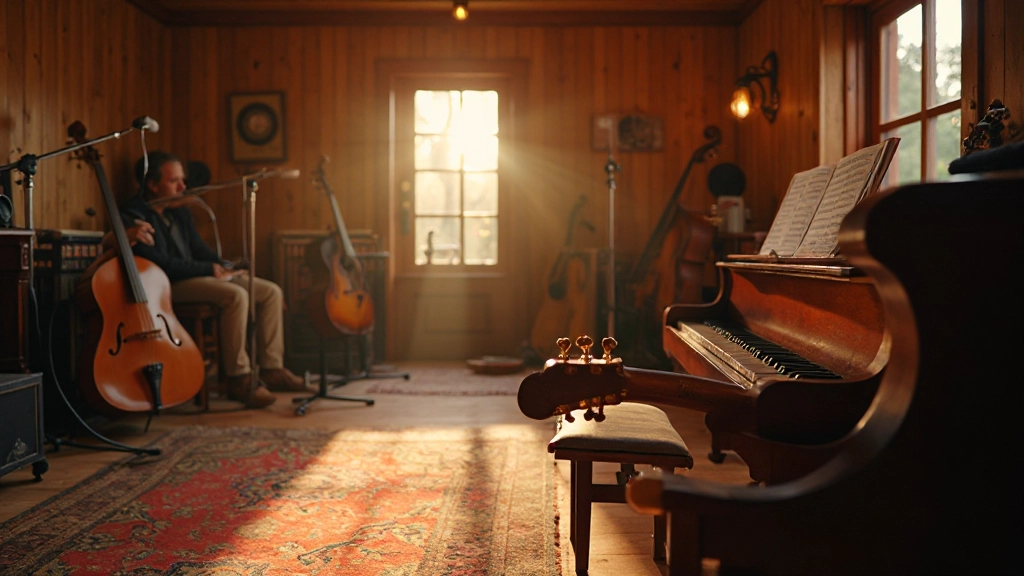
Three musicians sat in the control room, listening to playback of what should have been a gorgeous fingerstyle guitar piece. Instead, they heard something flat and lifeless—every note perfectly in tune, every timing precise, yet somehow missing the soul that made the original performance captivating.
"It sounds like a MIDI guitar," the guitarist said quietly. "But I swear it felt magical when I was playing it."
This scenario plays out in studios worldwide, from bedroom setups to professional facilities. Capturing the true essence of acoustic instruments requires more than good microphones and clean preamps. It demands understanding how organic sound sources interact with physical spaces, how our ears perceive natural resonance, and how mixing decisions can either enhance or destroy that delicate relationship.
Today we'll explore the art and science of recording and mixing acoustic instruments with genuine realism, drawing insights from engineers who've spent decades perfecting these techniques.
The Foundation: Why Acoustic Recording Differs from Everything Else
"People think acoustic recording is easier because there's no amp modeling or virtual instruments to worry about," explains Sarah Chen, a Nashville-based engineer who's worked with artists from Alison Krauss to Iron & Wine. "But acoustic instruments are actually the most demanding sources because they reveal everything—your room, your mic technique, your monitoring, even your cable quality."
Unlike electric instruments, acoustic sources generate complex harmonic content that extends well beyond their fundamental frequencies. A steel-string guitar doesn't just produce the notes being played; it creates sympathetic vibrations in unused strings, body resonance that varies with playing dynamics, and subtle percussive elements from fingernails and pick attack.
The Room Becomes Part of the Instrument
Chen recalls a session where a cellist couldn't understand why her instrument sounded thin in the mix. "We A/B'd her performance in our live room versus the isolation booth. Night and day difference. In the live room, you could hear the cello's low frequencies exciting the room's natural resonances. In the booth, it was just strings and wood with no context."
This reveals a crucial principle: acoustic instruments need space to develop their full tonal character. Even in smaller home studios, finding ways to give instruments breathing room—whether through mic placement, acoustic treatment, or mixing techniques—makes the difference between professional and amateur results.
Microphone Philosophy: Distance and Perspective Matter More Than Gear
Walk into most home studios and you'll see acoustic guitars recorded with a single microphone positioned inches from the 12th fret. While this approach can work, it often captures only a slice of the instrument's full voice.
"I learned this from watching classical recording sessions," says Mike Torres, an engineer who splits time between rock albums and chamber music. "Classical engineers don't mic every violin separately. They find the sweet spot where the instrument sounds most like itself in the room, then place microphones there."
The Three-Zone Approach
Torres advocates for thinking about acoustic recording in three distinct zones:
- Intimate Zone (6-18 inches): Captures attack, string noise, and playing details
- Musical Zone (2-4 feet): Where the instrument's fundamental character emerges
- Environmental Zone (4+ feet): Room interaction and natural reverb
"Most home recordists never leave the intimate zone," Torres explains. "They get obsessed with capturing every finger slide and pick scrape, but they miss the musicality that happens when the sound has space to develop."
"The microphone's job isn't to capture sound—it's to capture the experience of listening to that instrument in that space at that moment."
Practical Mic Placement for Common Instruments
For acoustic guitar, Torres suggests starting with a single microphone positioned roughly where your ear would be if you were sitting across from the player. "Point it at the junction between the neck and body, about three feet away. You'll be amazed how much more complete the guitar sounds compared to close-miking."
Piano recording follows similar principles. "Everyone wants to stick mics right over the hammers, but that's not where piano sounds like piano," Chen notes. "Try positioning microphones where a listener would sit—six to eight feet back, slightly elevated. You'll capture the instrument's bloom and the natural balance between bass and treble registers."
Managing Dynamics: The Make-or-Break Factor in Acoustic Mixing
Once you've captured good acoustic recordings, mixing becomes an exercise in restraint and enhancement rather than reconstruction. The biggest mistake engineers make is over-processing acoustic sources, trying to make them compete with compressed electric instruments and programmed drums.
"Acoustic instruments live in the dynamics," explains Chen. "A fingerstyle guitar piece might have a 20dB difference between the softest passage and the strongest chord. If you compress that down to 3dB, you've destroyed what made the performance compelling."
Selective Compression Strategies
Rather than applying broadband compression, both engineers advocate for frequency-selective dynamics control:
| Frequency Range | Typical Issues | Compression Approach |
|---|---|---|
| Sub-bass (20-80Hz) | Inconsistent low end, room rumble | High-pass filter, gentle limiting |
| Low-mids (80-300Hz) | Boomy resonances, hand noise | Multiband compression, slow attack |
| Presence (2-8kHz) | Harsh pick attack, string squeak | De-essing, frequency-specific limiting |
| Air (8kHz+) | Excessive brightness, digital harshness | Gentle high-frequency roll-off |
EQ Approaches: Enhancing Rather Than Correcting
Torres shares a story about mixing a folk album where the producer kept asking for the acoustic guitars to sound "bigger." "We spent hours adding low-mids and boosting presence, but it just sounded more processed. Finally, I tried cutting a narrow notch around 400Hz instead of adding anywhere. Suddenly the guitars opened up and sounded twice as big."
This illustrates a key principle in acoustic mixing: subtractive EQ often works better than additive. Acoustic instruments already contain their full frequency spectrum when well-recorded. The mixer's job is to remove conflicts and allow the natural character to shine through.
The Resonance Detective Approach
Chen recommends using a parametric EQ with a narrow Q setting to scan for problematic resonances: "Boost by 6-8dB and sweep slowly through the frequency spectrum. When you find frequencies that make the instrument sound unpleasantly resonant or boxy, cut those areas by 2-3dB with a moderate Q. It's like removing a blanket from the sound."
- Start with high-pass filtering to remove subsonic content
- Identify and gently cut resonant frequencies before boosting
- Use wide, gentle curves for tonal shaping
- Reference your EQ moves in context with the full mix
- Trust the original recording—less is usually more
Spatial Placement: Creating Depth Without Drowning the Source
Creating realistic spatial placement for acoustic instruments requires understanding how we perceive distance and environment in real acoustic spaces. "When someone plays guitar across the room from you, you don't just hear the direct sound," Torres explains. "You hear early reflections, room resonance, and complex delay patterns that tell your brain about the space."
In mixing, this translates to layered approaches that go beyond simple reverb sends:
The Three-Layer Spatial Model
Layer 1: Early Reflections
Short delays (5-25ms) with minimal feedback create the sense of immediate acoustic environment. "I use a simple delay plugin with about 12ms delay time, very low feedback, and mix it in subtly," Chen explains. "It gives the impression that the instrument exists in a real room rather than floating in digital space."
Layer 2: Room Ambience
Medium reverb (0.8-2.0 seconds) provides the sense of room size without overwhelming the source. Torres prefers plate reverbs for their musical quality: "Plates have this musical density that complements acoustic instruments better than hall algorithms. They add space without making everything sound like it was recorded in a cathedral."
Layer 3: Atmospheric Depth
Longer reverbs and modulated delays create depth and movement. "This layer is about emotion and musicality," Torres notes. "A tiny bit of modulated delay can make a solo acoustic guitar feel alive and breathing."
Monitoring and Reference: Training Your Ears for Acoustic Realism
Both engineers emphasize the importance of reference materials when mixing acoustic instruments. "I keep a playlist of acoustic recordings that sound incredibly natural and realistic," Chen explains. "When I'm questioning my mix decisions, I'll reference against these tracks to recalibrate my ears."
The key is choosing references that match your production goals. A solo singer-songwriter album requires different acoustic treatment than acoustic instruments in a full band context.
Common Pitfalls and How to Avoid Them
Through years of mixing acoustic-heavy projects, both engineers have identified patterns in what separates amateur from professional results:
Pitfall 1: Over-reliance on close miking
"Home recordists often close-mic everything because they're afraid of room sound," Torres observes. "But if your room sounds bad up close, it probably sounds bad far away too. Fix the room or find a better space rather than defaulting to intimate miking."
Pitfall 2: Applying rock/pop processing to acoustic sources
"The compression and EQ that works on electric guitars will destroy acoustic instruments," Chen warns. "Acoustic sources need gentler touch and different philosophical approach."
Pitfall 3: Fighting the instrument's natural character
"I've seen engineers spend hours trying to make a nylon-string guitar sound bright and punchy," Torres says. "Sometimes the answer is choosing a different instrument or accepting the instrument's inherent character and building the arrangement around it."
Bringing It All Together: A Philosophical Shift
As our conversation wound down, both engineers returned to a central theme: acoustic recording and mixing requires a different mindset than working with electronic sources.
"With synthesizers or sample libraries, you're building sounds from scratch," Chen reflects. "With acoustic instruments, you're capturing and enhancing something that already exists in the physical world. Your job is to translate that three-dimensional, dynamic experience into a recording that feels equally alive."
This shift in thinking—from constructor to translator—changes everything about how you approach acoustic sources. Instead of asking "How can I make this sound better?" you ask "How can I best represent what this actually sounds like in this space at this moment?"
The guitarist from our opening story eventually got his magical performance captured. It required moving to a different room, repositioning microphones, and trusting that sometimes the best mixing move is the lightest touch. When acoustic instruments breathe naturally in your mix, they transform from mere sounds into musical experiences that connect directly with listeners' emotions.
Hear what these choices do to your own song.
Upload stems or a finished track, choose a reference direction, and compare a private Moozix mix before you export anything.