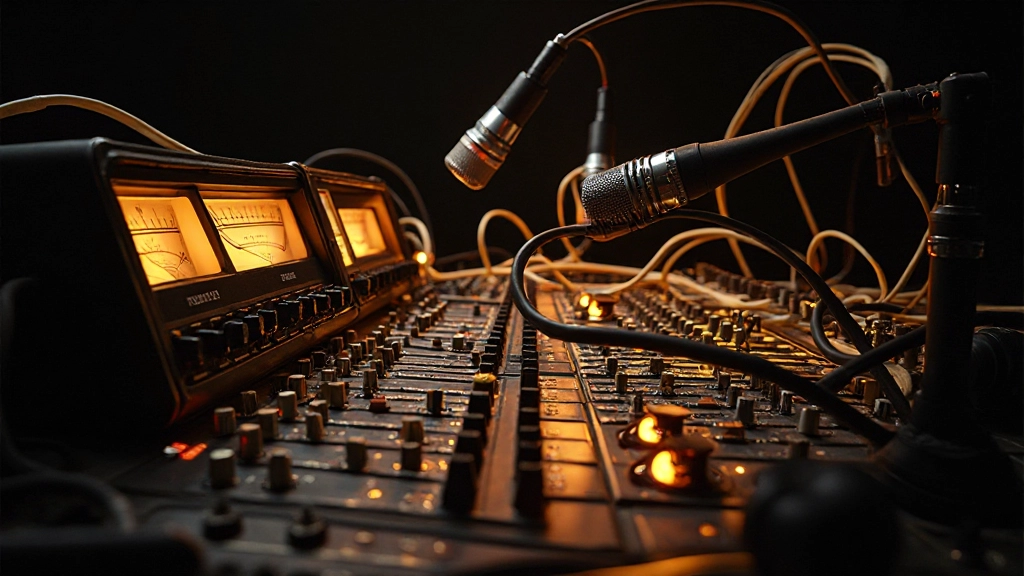
Rebecca sat in her bedroom studio at 2 AM, staring at her latest mix with growing frustration. The lead vocal sounded powerful in her headphones but completely disappeared when she switched to her monitors. The phantom-powered condenser mic she'd saved up for was supposed to solve everything, yet her center image kept collapsing into mush. Three months and dozens of failed mixes later, she discovered that nearly everything she believed about phantom power, center panning, and stereo imaging was wrong.
The Phantom Power Fairy Tale That Costs You Clarity
The most persistent myth in home recording circles claims that phantom power automatically delivers professional sound quality. Walk into any guitar store, and you'll hear it repeated like gospel: "Condensers need phantom power, so phantom power equals better recordings." This oversimplification has derailed more bedroom productions than bad acoustics and cheap interfaces combined.
During a session with indie folk artist Trevor Goodwin, I watched him struggle with this exact misconception. His audio interface proudly displayed those little "+48V" indicators, but his vocal recordings sounded thin and lifeless compared to the demo he'd cut on his phone. The problem wasn't technical—it was conceptual.
Phantom power simply provides electrical current to condenser microphones. It doesn't enhance sound quality, add warmth, or magically improve your mix. Think of it like electricity to a light bulb: necessary for function, but not responsible for how well the room is lit. The real magic happens in microphone placement, room acoustics, and gain structure.
Why Your Centered Vocals Sound Like They're Coming From Everywhere
Center panning should be simple: route the vocal to the middle, and it sits perfectly between your speakers. Yet countless mixers report that their centered elements sound unfocused, wandering, or weak. The culprit isn't the panning—it's phase coherence and stereo monitoring setup.
Last winter, producer Angela Chen brought me a mix that exemplified this problem perfectly. Her lead vocal was panned dead center, but it seemed to float around the stereo field like a lost tourist. We spent an afternoon discovering that her studio monitors were positioned incorrectly, creating a phantom center that existed only in theory.
True center imaging requires precise speaker placement and time alignment. If your monitors aren't equidistant from your listening position, or if one speaker is even slightly delayed, your phantom center becomes an actual phantom—present but unstable. This instability makes centered elements feel weak and unfocused, regardless of how you process them.
| Monitor Setup Issue | Impact on Center Image | Quick Fix |
|---|---|---|
| Unequal distances | Wandering vocal position | Measure and adjust speaker placement |
| Different heights | Vertical center shift | Tilt speakers toward ear level |
| Wall reflections | Smeared imaging | Add absorption behind speakers |
| Room modes | Frequency-dependent wandering | Test different listening positions |
The Stereo Width Trap That Kills Your Low End
Modern mixing tutorials preach stereo width as the holy grail of professional sound. Wider is better, they claim, and anything mono is amateurish. This philosophy has created a generation of mixers who spread everything across the stereo field, then wonder why their low end lacks power and focus.
Bass frequencies below 100Hz are naturally omnidirectional in most listening environments. When you pan bass elements hard left or right, you're not creating width—you're creating confusion. The wavelengths are so long that stereo speakers can't accurately reproduce their directional information. Instead, you get phase cancellation in mono playback and weakened impact on single-speaker systems.
I learned this lesson during a rock session with drummer Jake Martinez. His kick drum was perfectly positioned in the stereo field during mixing, but completely vanished when we checked mono compatibility. The stereo enhancement plugin he'd applied was creating artificial width by introducing phase differences that destroyed mono translation.
- Keep bass content centered: Pan kick drums, bass guitars, and sub-bass elements to the center position
- Create width with mid-frequencies: Use the 200Hz-3kHz range for spatial interest without losing low-end power
- Test mono regularly: If elements disappear in mono, they'll sound weak on most playback systems
- Use complementary panning: Balance left-panned elements with similar-frequency content on the right
When Condenser Mics Make Everything Worse
The condenser microphone myth runs deeper than phantom power requirements. Many home recordists believe that condensers automatically capture more detail and professional sound than dynamic mics. This belief leads to poor microphone choices that emphasize room problems and noise rather than musical content.
Condensers are incredibly sensitive—that's both their strength and their weakness. In untreated rooms, this sensitivity becomes a liability. They capture every reflection, every air conditioning hum, and every footstep from upstairs with the same fidelity as your musical performance. Dynamic microphones, with their focused pickup patterns and lower sensitivity, often deliver cleaner recordings in challenging environments.
"I spent two years fighting my condenser mic before realizing that my SM57 was giving me everything I actually wanted. Sometimes the right tool isn't the most expensive tool."
The frequency response of condensers also emphasizes high frequencies, which can expose harshness and sibilance that dynamic mics naturally tame. If your mix consistently sounds too bright or brittle, the problem might not be your EQ technique—it might be your microphone choice.
The Haas Effect Confusion That Destroys Timing
The Haas effect describes how our ears perceive the direction of sounds that arrive at slightly different times. Mixing tutorials often present this as a stereo widening trick: duplicate a mono source, delay one copy by 10-30 milliseconds, and pan them apart for "instant width." This technique creates more problems than it solves.
When bassist Carlos Rivera and I experimented with Haas effect processing on his recording, we discovered that the delayed duplicate was creating rhythmic confusion rather than spatial enhancement. The 15-millisecond delay was just enough to make the bass feel sluggish and out of time with the drums, even though both were perfectly synchronized.
Modern ears, trained on digital precision, are sensitive to these micro-timing differences. What might have sounded like natural room ambience in the analog era now sounds like a technical error. The brain constantly fights to reconcile the timing difference, creating listening fatigue and rhythmic uncertainty.
- Don't use Haas delays on rhythmically important elements like drums or bass
- Reserve Haas processing for ambient textures and sustained elements
- Avoid delays longer than 5ms on elements that need to sound tight
- Use natural reverb and chorus for width instead of timing tricks
Why Stereo Enhancement Plugins Lie to Your Ears
Digital stereo enhancement tools promise to transform narrow recordings into wide, immersive soundscapes with a single plugin. These tools work by manipulating phase relationships and frequency content to create the illusion of width. The illusion part is crucial—and problematic.
Most stereo enhancers achieve their effect by emphasizing differences between left and right channels while reducing similarities. This process can make a mix sound impressive in isolation, but it often destroys mono compatibility and creates translation issues across different playback systems. What sounds wide and exciting on studio monitors might sound hollow and weird on a Bluetooth speaker.
During a mixing session with electronic artist Whitney Park, we A/B tested her track with and without stereo enhancement. The enhanced version sounded more impressive initially, but after 20 minutes of listening, ear fatigue set in. The enhanced mix was working our hearing system harder, requiring constant adjustment to process the artificial spatial information.
The Mid-Side Processing Myth That Complicates Everything
Mid-side (M/S) processing has gained popularity as a sophisticated mixing technique that provides independent control over center and stereo information. Tutorials present M/S as a professional secret that separates amateur mixers from the pros. In practice, M/S processing often introduces complications without delivering meaningful benefits.
The M/S matrix splits stereo signals into mid (center) and side (stereo difference) components. This allows you to process center and stereo information independently—EQing the lead vocal without affecting the stereo guitars, for example. However, this flexibility comes with phase complexity that can create more problems than it solves.
Engineer Tom Patterson shared his experience with M/S during a mastering session: "I spent hours tweaking the mid and side channels separately, thinking I was being sophisticated. When I bypassed all the M/S processing and used simple stereo EQ instead, the mix immediately sounded more coherent and musical. Sometimes the direct path is the right path."
| M/S Advantage | Real-World Downside |
|---|---|
| Independent center/side control | Phase relationships become unpredictable |
| Precise stereo width adjustment | Artificial-sounding width that doesn't translate |
| Professional appearance | Complexity that distracts from musical decisions |
| Surgical precision | Analysis paralysis and over-processing |
Building Solid Phantom Power Habits That Actually Matter
Understanding phantom power begins with recognizing what it actually controls. Phantom power enables condenser microphones to function, but it doesn't determine recording quality. The quality comes from proper gain staging, microphone placement, and acoustic environment management.
When you engage phantom power, you're simply completing an electrical circuit. The real work happens in the analog domain—the physical interaction between sound waves, microphone diaphragm, and preamp circuitry. Digital processing can enhance or destroy this foundation, but it can never replace proper capture technique.
Modern audio interfaces often provide phantom power switches for individual channels. Use this granular control to power only the channels that need it. Unnecessary phantom power creates additional electrical noise in your signal chain, even if the difference is subtle.
The path forward involves building recording and mixing skills based on acoustic principles rather than digital myths. Your center image improves through better monitoring setup and phase awareness, not through plugins that promise instant width. Your recordings gain professional character through microphone technique and gain structure, not through phantom power alone.
Rebecca's breakthrough came when she stopped chasing phantom power solutions and started addressing her actual problems: room acoustics, monitor placement, and gain staging. Her bedroom studio still uses the same interface and microphones, but her mixes now translate across playback systems because she builds them on solid technical foundations rather than persistent myths.
Hear what these choices do to your own song.
Upload stems or a finished track, choose a reference direction, and compare a private Moozix mix before you export anything.