Balance
Levels should feel intentional, not accidental. The important parts need a clear hierarchy.
When a song is arranged but not finished, you don't always need a long back-and-forth with an engineer. Sometimes you need to upload the stems, hear a stronger direction, and find out whether the vocal, beat, low end, drums, and instruments can finally sit together.
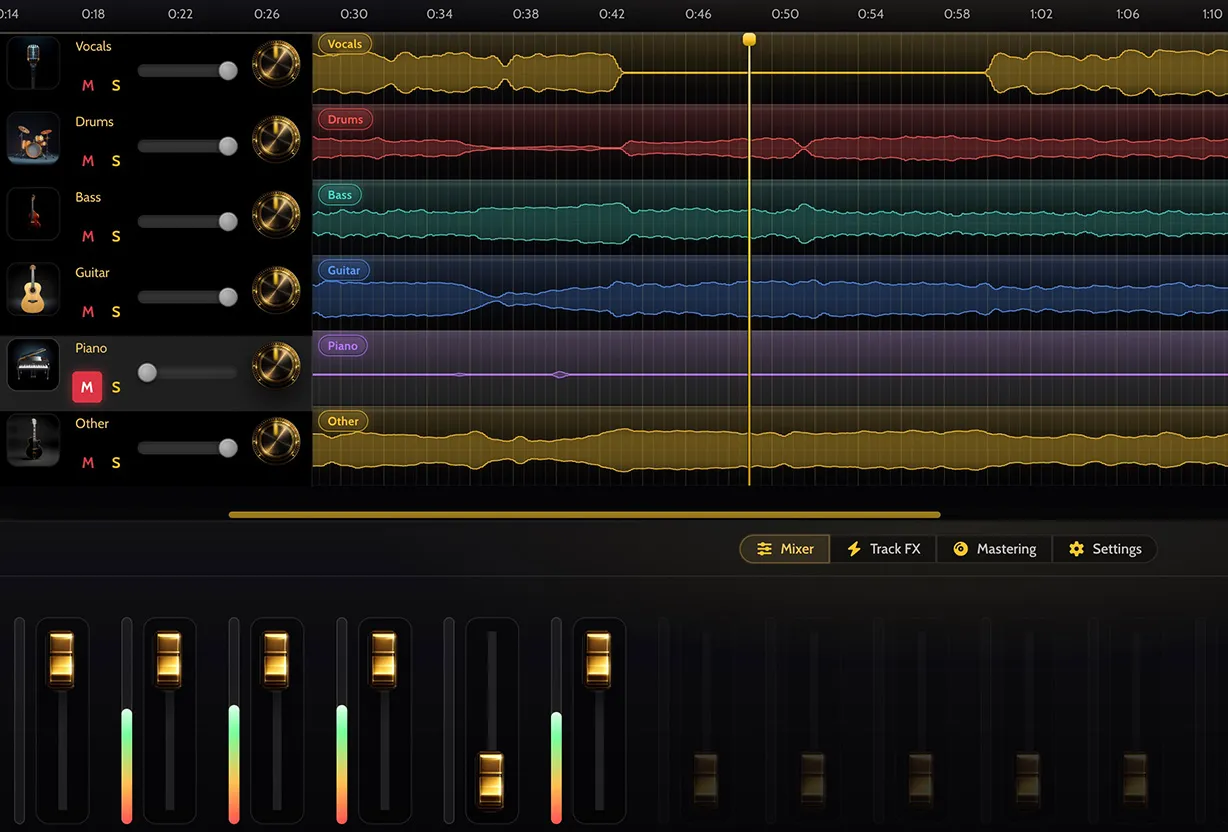
A useful mix doesn't just add processing. It tells the listener where to focus. The vocal stops fighting the beat. The kick and bass stop blurring. Instruments stop hiding the hook. The master gets a cleaner source to finish.
Levels should feel intentional, not accidental. The important parts need a clear hierarchy.
Mud, harshness, thinness, and dullness usually come from parts masking each other.
Dry, wet, close, far, wide, and center all matter. Space should support the song, not cover it.
Vocals, bass, and drums should stay controlled without feeling flattened.
The mix should survive earbuds, cars, phones, and laptop speakers better than the rough version did.
Mastering should add final polish after the mix has stopped fighting itself.
Moozix is built for the moment after recording and arranging, when the idea is alive but the mix isn't there yet.
The idea is strong, but the faders and plugin chain keep turning into guesswork.
The vocal and beat need to feel like one record instead of two files stacked together.
Drums, bass, guitars, keys, and vocal need a better stage before the final master.
Low end, drums, samples, and toplines need energy without crowding the center.
Synths, kick, bass, drops, and width need control before loudness gets pushed.
Processed stems make it easier to keep revising after the automatic mix direction works.
That's the core difference. If you only have one finished bounce, Moozix can master it or help you move into a stem workflow. If you have stems, the mix can actually change before the final master.
Good for mastering when the mix already works. Limited when a specific part is too loud, too quiet, too harsh, or too muddy.
Better for mix repair because vocals, beat, drums, bass, guitars, keys, and instruments can be shaped in context.
Moozix can help move the mix in a better direction, but your uploads still matter. Clean stems, a useful rough mix, and a sane reference give the process a much better shot than a folder full of clipped, random exports.
For a rap track, that may be lead vocal, ad-libs, beat, bass, and drums. For a band demo, it may be drums, bass, guitars, keys, lead vocal, and backing vocals. The stems should match what a listener needs to understand.
Even if the rough mix is flawed, it shows your taste: how loud you imagine the vocal, how big the drums should feel, whether the track should be dry, wide, aggressive, warm, or close.
Clipping, heavy room noise, bad edits, timing problems, and distorted stems should be fixed as early as possible. Mixing can improve relationships. It cannot make every damaged source sound like it was recorded cleanly.
Stems unlock the most control. A finished stereo mix still has a place when the balance is already good.
An online mixing service should not just process audio. It should make the song easier to understand.
If the vocal sits better, the low end stops smearing, the drums carry more weight, and the final master has less to fight, the mix has moved in the right direction.The more specific your source files, the more specific the fix can be.
Moozix is a self-serve AI mixing and mastering tool. It can work from stems to improve the mix, then create a finished master.
It is useful for bedroom producers, rappers with vocals and beats, singer-songwriters, rock demos, electronic producers, and artists who want a stronger mix direction without a long manual revision process.
Yes, but a stereo file limits what can be fixed. Stems give Moozix more control over vocals, drums, bass, beat, guitars, keys, and instruments.
You can preview the result free. Pro unlocks final exports such as 24-bit WAV masters, MP3 previews, premaster mixes, and processed stems when available.
No. A traditional engineer can make detailed creative decisions through revisions. Moozix is a faster self-serve path for artists who want a stronger mix direction and master from their stems.
A better mix should make the song easier to follow: clearer vocal, tighter low end, stronger drums, less harshness, better width, and a final master that has something solid to finish.
Use clean stems or grouped parts when possible. Raw multitracks can be too messy if they are not organized, named clearly, aligned from the same start point, and exported without clipping.
Yes, especially for vocal-forward music. Separate vocal and beat files give more control than one full bounce, though drum, bass, and music stems can help when the beat itself is crowded.
Export from the same start point, avoid clipping, name files clearly, remove muted junk, and keep a rough mix so Moozix has context for how you hear the song.
Yes. The point is to improve the balance first when needed, then create a final master from a version of the song that is not fighting itself.
The song should feel clearer at the same volume: vocal easier to follow, low end less cloudy, drums more confident, and fewer parts fighting for the same space.
Preview the mix direction free. Export when the result is ready to keep.