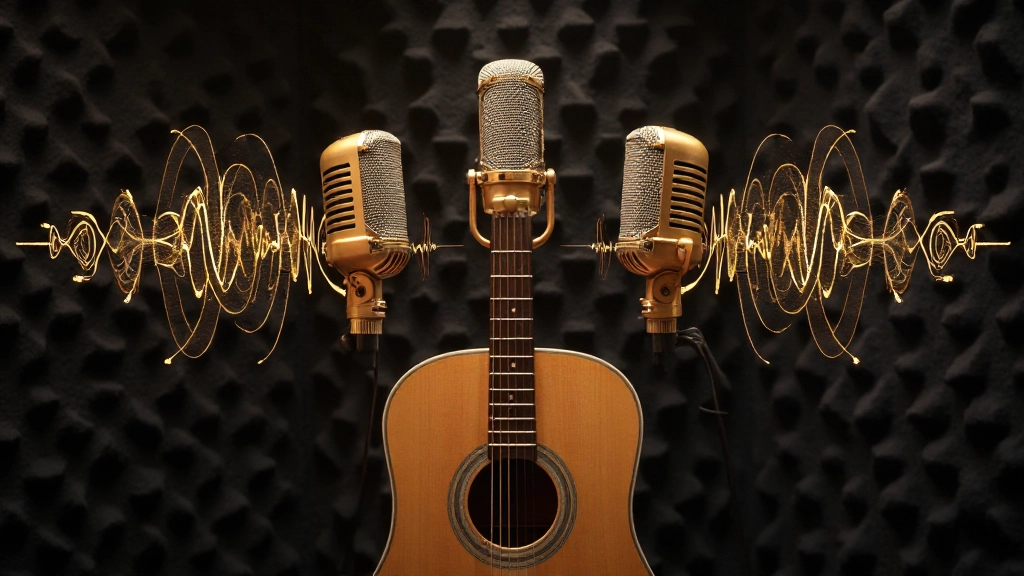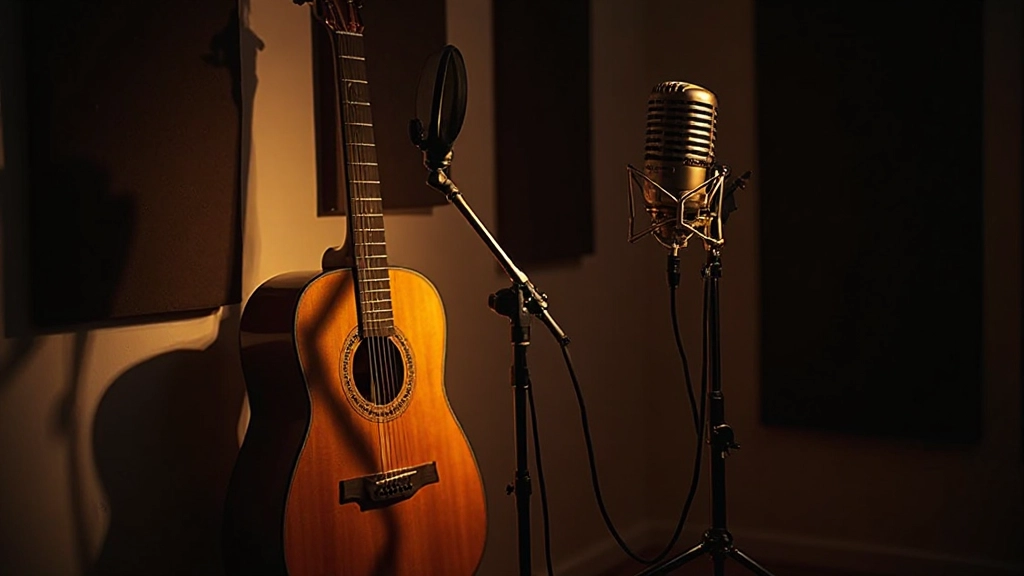
The studio clock read 2:47 AM when Derek finally stopped the playback and rubbed his eyes. Three hours of takes, six different mic positions, and every recording sounded like cardboard. His Martin D-28 - the same guitar that sang so beautifully in his living room - turned wooden and lifeless the moment he pressed record.
This scenario plays out in home studios everywhere. Acoustic guitars that sound rich and resonant in person become flat, narrow, and somehow smaller when captured through microphones. The culprit isn't your guitar or your playing - it's the complex relationship between acoustic instruments, room acoustics, and microphone technique that separates amateur recordings from professional captures.
The Acoustic Reality Check
Recording acoustic guitar isn't just about pointing a microphone at your instrument. Unlike electric guitars, where the amp becomes part of the sound design, acoustic guitars rely entirely on wood resonance, air movement, and three-dimensional space to create their voice. When we compress that complexity into a recording, we're asking a microphone to capture not just the strings, but the entire acoustic system working together.
The challenge becomes even more complex in home studios, where untreated rooms can either kill natural resonance or add unwanted reflections that muddy the recording. Professional studios spend thousands on acoustic treatment specifically to control how acoustic instruments interact with their environment.
The Foundation: Understanding Your Guitar's Voice
Before placing a single microphone, you need to understand how your specific guitar projects sound. Walk around your instrument while playing, listening for where the tone feels most balanced. Most guitars have distinct sonic zones - the brightness near the neck joint, the fullness over the sound hole, and the woody body resonance from the lower bout.
Professional recording engineer Janet Morrison discovered this principle during sessions with folk artist Riley Chen last winter. "I spent twenty minutes just listening to Riley play from different positions in the room before I even unpacked a microphone," Morrison recalls. "His Guild had this beautiful woody growl that only appeared when you listened from about three feet away and slightly to the right. Once I found that sweet spot, the mic placement became obvious."
This listening phase reveals your guitar's natural projection pattern. Some instruments project evenly in all directions, while others focus their energy in specific zones. Fingerstyle guitars often sound best captured from positions that emphasize the upper bout resonance, while strummed parts might benefit from positions that capture the full body movement.
Strategic Microphone Placement for Dimension
Single microphone techniques work well for simple arrangements, but creating truly dimensional acoustic guitar recordings often requires understanding how multiple mic positions interact. The classic approach combines a close mic for string detail with a more distant mic capturing body resonance and room character.
| Position | Distance | Character | Best For |
|---|---|---|---|
| 12th Fret | 6-8 inches | String clarity, note definition | Fingerstyle, lead parts |
| Bridge Area | 8-12 inches | Body resonance, warmth | Strumming, rhythm |
| Upper Bout | 12-18 inches | Full body, natural balance | Solo performances |
| Room Position | 2-4 feet | Space, dimension | Ambient blend |
The magic happens when you blend these perspectives during mixing. Engineer Carlos Rodriguez learned this technique while working on an indie folk album where the acoustic guitar needed to cut through dense arrangements without losing its organic character. "I used a close dynamic mic for the attack and string detail, then blended in a small diaphragm condenser positioned to catch the body resonance," Rodriguez explains. "The combination gave us both clarity and that three-dimensional quality that makes you feel like the guitarist is in the room with you."
Room Control Without Killing Life
Home studios present unique challenges for acoustic recording. Untreated rooms can add unwanted reflections, while over-treated spaces can suck the life out of acoustic instruments. The goal isn't to eliminate room sound entirely, but to control it strategically.
Moving blankets and furniture can create temporary acoustic treatment that tames reflections without deadening the space completely. Position acoustic absorbing materials behind the guitarist and to the sides, but leave some reflective surfaces to maintain natural resonance. Many engineers prefer recording acoustic guitars in corners where wall intersections create natural bass trapping.
- Test your room's character: Record a simple chord progression from different positions in your space
- Identify problem reflections: Listen for flutter echoes or boomy resonances
- Use strategic absorption: Place blankets or foam only where needed
- Preserve some reflection: Keep some hard surfaces for natural ambience
- Experiment with distance: Sometimes moving further from walls improves the sound
Performance Technique That Serves the Recording
Recording technique and performance technique work together in acoustic guitar capture. Small changes in playing dynamics, pick angle, and finger placement can dramatically affect how your guitar translates through microphones. Professional session players develop recording-specific techniques that help their instruments cut through mixes while maintaining musical expression.
Pick selection becomes crucial during recording. Harder picks create more string attack and high-frequency content, which can help acoustic guitars maintain presence in full mixes. Fingerstyle players often adjust their nail length and angle specifically for recording sessions, knowing that microphones capture subtleties that might be inaudible during live performance.
"I learned to play slightly harder for recording than I would in a live setting. Microphones don't capture the full dynamic range of acoustic instruments the way our ears do."
Multi-Track Approaches for Rich Textures
Creating rich acoustic guitar textures often involves recording multiple passes rather than trying to capture everything in a single take. This approach allows you to build complexity while maintaining clarity for each individual element. Different tunings, capo positions, and playing techniques can create ensemble-like depth from a single instrument.
The key to successful multi-tracking lies in making each pass serve a specific function in the overall arrangement. One pass might focus on low-end rhythm foundation, while another emphasizes mid-range harmonic content. A third pass could add high-register melodic elements or percussive techniques.
- Record foundation rhythm first with consistent dynamics
- Add harmonic layers using different positions on the neck
- Include percussive elements like palm muting or body percussion
- Consider alternate tunings for unique harmonic content
- Use capo positions to access different tonal registers
EQ and Processing That Enhances Natural Character
Post-recording processing should enhance your acoustic guitar's natural character rather than fundamentally changing it. The goal is to help the recorded sound match what you heard in the room while addressing any technical limitations of the recording process.
High-pass filtering removes unnecessary low-frequency content that can muddy mixes, but be careful not to filter so aggressively that you lose the guitar's natural body resonance. Most acoustic guitars benefit from gentle high-frequency enhancement around 10-12 kHz to restore some of the air and sparkle that recording compression can diminish.
Compression requires a delicate touch with acoustic instruments. Heavy compression can destroy the natural dynamics that give acoustic guitars their musical expression. Instead, use gentle compression ratios (2:1 or 3:1) with slower attack times that allow the natural string attack to pass through unprocessed.
Common Pitfalls and How to Avoid Them
The most common mistake in acoustic guitar recording is positioning microphones too close to avoid room sound. While close miking reduces unwanted reflections, it also eliminates the air movement and body resonance that make acoustic guitars sound natural and three-dimensional.
Another frequent issue involves over-processing during mixing. Acoustic guitars that sound natural and musical during recording can quickly become artificial and sterile when subjected to heavy EQ, compression, and effects. Trust your recording technique and use processing sparingly to enhance rather than correct.
String noise presents challenges for many home recordists. Rather than trying to eliminate string noise entirely through technique or processing, embrace it as part of the acoustic guitar's natural character. Excessive noise reduction can make acoustic instruments sound synthetic and lifeless.
Building Your Acoustic Recording Setup
Developing consistent acoustic guitar recording results requires understanding your specific equipment and space. Document successful microphone positions, room treatments, and processing settings so you can recreate good results reliably. Many engineers keep detailed session notes specifically for acoustic recording setups.
Invest time in understanding how your microphones respond to acoustic instruments. Different microphone types and models have distinct characteristics that can either enhance or detract from your guitar's natural sound. Small diaphragm condensers often work well for capturing string detail, while large diaphragm mics excel at body resonance.
Consider your monitoring environment when making recording decisions. If your mixing setup doesn't accurately represent low-frequency information, you might overcompensate during recording, capturing too much or too little body resonance. Accurate monitoring helps you make better decisions during the recording process.
Remember that great acoustic guitar recordings start with great acoustic guitar performances. No amount of technical expertise can substitute for musical expression and solid playing technique. Focus on capturing performances that serve the song while using recording technique to enhance rather than correct the musical content.
The path from wooden recordings to warm, dimensional acoustic guitar captures requires patience, experimentation, and attention to the musical as well as technical aspects of the process. When everything aligns - the performance, the recording technique, and the processing - acoustic guitars can become the emotional centerpiece that transforms entire mixes from good to unforgettable.
Hear what these choices do to your own song.
Upload stems or a finished track, choose a reference direction, and compare a private Moozix mix before you export anything.