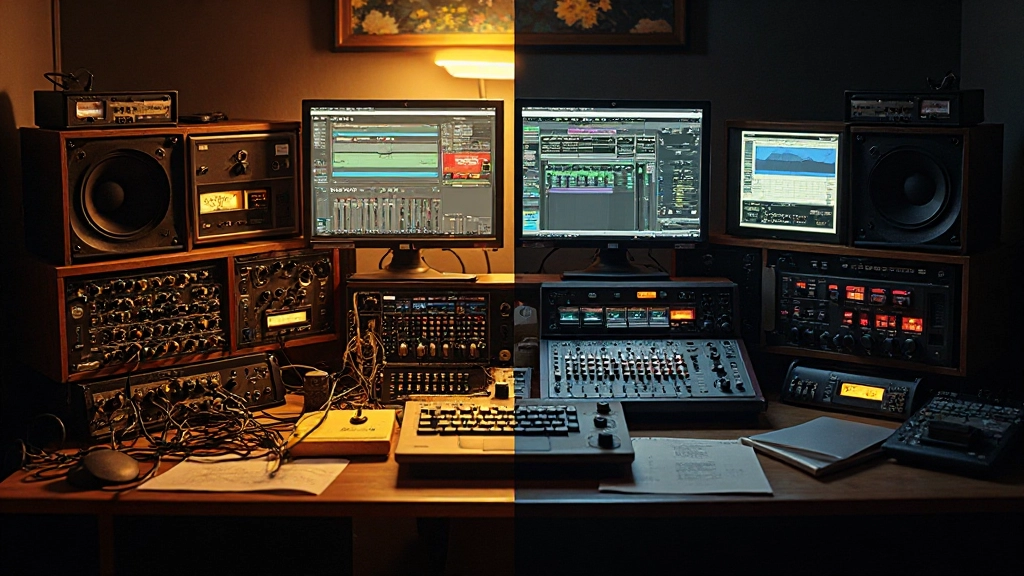
The phone rang at 2 AM. Preston had been mixing the same chorus for six hours, riding faders and tweaking EQ curves until his ears felt like cotton. The vocalist wanted more brightness, the guitarist insisted the solo needed to cut through better, and the drummer kept asking why his snare didn't have enough crack. When Preston finally answered the call, it was his mastering engineer asking a simple question that changed everything: "Are you trying to fix the song, or are you trying to finish the song?"
That question exposed the fundamental confusion plaguing home studio producers everywhere. We approach mixing and mastering with the same mindset, using the same thought processes, making the same types of decisions. But the best engineers know something most of us miss: these are two completely different art forms requiring opposite ways of thinking.
The Detective vs The Surgeon: Two Different Minds
When veteran mastering engineer Diana Chen sits down at her console, she doesn't think like a mixer. "Mixing is detective work," she explains during our conversation at her Nashville facility. "You're investigating every element, solving problems, building relationships between instruments. Mastering is surgery. You're making precise, minimal interventions on a patient that's already stable."
This distinction isn't just philosophical. It shapes every technical decision from the moment you hit play. In mixing mode, Preston was hunting for problems in individual elements. He'd solo the kick drum, sweep through frequencies, add compression to taste, then build the mix piece by piece. But mastering requires what Diana calls "whole-body listening."
Core Principle
Mixing asks "What does each element need?" Mastering asks "What does the complete musical statement need?"
The technical implications run deep. A mixer might boost 3kHz to add presence to a vocal, then cut 3kHz in the guitar to make room, then add a high shelf to the overheads for air. A mastering engineer hears the vocal sitting exactly where it needs to be in the complete frequency spectrum and leaves it alone, even if it might sound thin in isolation.
Decision Speed: When Fast Beats Perfect
Watch a seasoned mastering engineer work and you'll notice something unsettling: they make decisions incredibly quickly. While Preston spent twenty minutes auditioning compressor settings on his mix bus, Diana makes mastering moves in under sixty seconds.
"The mix has already solved the detailed problems," Diana explains. "If I'm spending more than a minute deciding whether to add 0.5dB at 8kHz, I'm thinking like a mixer, not a mastering engineer."
This speed isn't recklessness. It comes from listening with different priorities. During our session, Diana demonstrates by playing an indie rock track through her monitoring chain. Within fifteen seconds, she identifies three characteristics: the low-mid buildup making the bass feel woolly, the slightly harsh cymbal crashes, and the overall dynamic compression that's making the chorus feel flat.
| Mixing Mindset | Mastering Mindset |
|---|---|
| Detailed problem-solving per element | Broad strokes on complete musical statement |
| Extended auditioning of options | Quick, confident decisions |
| Building relationships between parts | Enhancing existing relationships |
| Creative exploration and experimentation | Focused enhancement and translation |
| Fixing what's broken | Optimizing what's working |
Her moves are surgical: a gentle high-pass filter at 35Hz to clean up sub-harmonic rumble, a 1dB reduction at 400Hz with a moderate Q, and a subtle multiband compressor to restore some punch to the chorus. Three moves, ninety seconds, problem solved.
The Reference Flip: Internal vs External Standards
Perhaps the biggest mindset shift involves reference standards. When mixing, Preston constantly A/B's against other tracks in the genre. He'll pull up three or four commercial releases, matching levels, analyzing frequency balance, and trying to get his mix to compete in that sonic landscape.
Diana approaches references differently. "I'm not trying to make this sound like anything else," she says while switching between the raw mix and her processed version. "I'm trying to make this sound like the best possible version of itself."
This distinction prevents the over-processing that plagues many home studio masters. When you're chasing external references, you start pushing your master toward someone else's aesthetic. When you're honoring the internal logic of the mix, you enhance what's already there.
"The mix tells you what it wants to become. Your job is to listen carefully enough to hear it."
During our session, Diana plays a folk track with an intimate, close-mic'd vocal and minimal instrumentation. "If I tried to make this sound like a pop record, I'd destroy everything beautiful about it," she explains. Instead, she adds subtle harmonic saturation to warm up the digital recording chain and applies gentle bus compression to glue the sparse elements together.
Frequency Thinking: Trees vs Forest
The EQ decisions that work in mixing can be disastrous in mastering, and vice versa. This isn't just about being more subtle. It's about thinking in terms of musical balance rather than technical correction.
"In mixing, I might boost 2-5kHz on a snare drum to help it cut through a dense arrangement," explains mixing engineer Riley Santos, who regularly collaborates with Diana. "But if Diana hears harshness in that same frequency range during mastering, she's not thinking about the snare specifically. She's thinking about how that frequency range affects the emotional impact of the entire song."
This difference in thinking leads to different tool choices. Riley uses narrow-Q EQ moves to carve space for individual elements. Diana uses broad, gentle curves that affect multiple instruments simultaneously, preserving the relationships Riley built while adjusting their collective weight in the spectrum.
- Mixing EQ: Narrow Q, specific problem solving, individual element focus
- Mastering EQ: Broad Q, musical balance, whole-mix impact
- Mixing goal: Clear separation and definition
- Mastering goal: Enhanced cohesion and translation
Compression Philosophy: Glue vs Control
The difference in compression philosophy might be the starkest contrast between mixing and mastering mindsets. During mixing, compression serves multiple masters: controlling dynamics, adding color, creating space, shaping transients. Each compressor has a specific job on a specific element.
Mastering compression has one primary job: creating unified behavior across the entire frequency spectrum. "I'm not trying to control the kick drum or tame the vocal," Diana explains while adjusting her bus compressor. "I'm trying to make the entire song breathe as one organism."
This leads to dramatically different settings. Where a mixing compressor might grab 3-6dB of gain reduction with medium-fast attack times, Diana's mastering compressor barely moves the needle, providing 1-2dB of gentle gluing with slower attack times that preserve the natural dynamics of the mix.
"If I'm hearing individual instruments getting compressed, I'm working too hard," she notes. "Good mastering compression should be felt more than heard."
The Loudness Paradox
This gentler approach to compression reveals one of the biggest paradoxes in mastering: songs often feel louder when you compress them less aggressively. Preston discovered this the hard way when comparing his heavily limited masters to Diana's more dynamic versions.
"My masters measured louder on the LUFS meter," Preston recalls, "but hers felt more powerful when you played them back to back. She was preserving the impact of the transients that my limiting was crushing."
Workflow Rhythms: Marathon vs Sprint
The two disciplines operate at completely different tempos. Mixing encourages deep dives, extended experimentation, and iterative refinement. You might spend an entire day getting the drum sound right, then another day building the perfect vocal chain.
Mastering demands efficiency and decisiveness. Diana typically spends 30-45 minutes per song, making quick assessment passes and implementing targeted solutions. "If I'm not done in an hour, I'm probably overthinking it," she explains.
This time constraint isn't arbitrary. It reflects the different cognitive loads of the two processes. Mixing requires sustained creative problem-solving across dozens of individual elements. Mastering requires intense focus on the complete musical statement, which is mentally exhausting in a different way.
- Assessment Pass (5-10 minutes): Listen to the entire song without touching anything, taking notes on broad strokes needed
- Technical Pass (10-15 minutes): Address any obvious technical issues like DC offset, phase problems, or excessive resonances
- Musical Pass (15-20 minutes): Make EQ, compression, and saturation moves to enhance the musical impact
- Validation Pass (5-10 minutes): A/B against the original and check translation on different monitoring systems
When to Switch Mindsets
For home studio producers wearing both hats, knowing when to make the mental switch becomes crucial. The transition isn't just about finishing your mix and opening a mastering plugin. It requires a complete change in listening perspective.
"I wait at least 24 hours between finishing a mix and starting the master," Preston explains. "But more importantly, I change my entire setup. Different monitoring level, different listening position, sometimes even different speakers. I need to hear the mix like a mastering engineer would."
Critical Transition Point
If you find yourself soloing individual tracks during mastering, stop immediately. You've slipped back into mixing mode and need to reset your perspective.
This physical and mental reset helps prevent the most common home studio mistake: trying to fix mixing problems during mastering. "If the vocal isn't sitting right in the mix, no amount of mastering EQ is going to fix that properly," Diana warns. "You need to go back and address it in the mixing stage."
The Translation Test
Perhaps the clearest way to understand the difference in mindsets is to consider what success looks like. A successful mix translates well to mastering. A successful master translates well to the real world.
This means mastering engineers think constantly about playback scenarios that mixers can ignore. Diana's studio includes everything from high-end monitors to a basic boom box to car speakers. "The mix might sound perfect on expensive monitors," she explains, "but if it falls apart on earbuds or in a car, I haven't done my job."
This translation focus influences every decision. That smooth, warm low-end that sounds gorgeous in the mixing room might turn to mud on smaller speakers. Those crispy hi-hats that add excitement on studio monitors might become ear-piercing on bright earbuds.
Building Better Boundaries
Understanding these different mindsets doesn't just make you better at mixing and mastering. It helps you know when you're using the wrong approach for the task at hand. Preston's late-night mixing marathon was really a mastering problem disguised as a mixing crisis. He was trying to polish and finalize when he should have been building and exploring.
"Now when I catch myself making tiny adjustments and second-guessing every decision, I know I've shifted into mastering mode too early," Preston explains. "And when I'm mastering and I start wanting to fix individual instruments, I know I need to step back and think about the big picture."
The best engineers develop clear internal signals that tell them which mindset they're operating from. Diana describes it as switching between microscope and telescope vision. "Mixing is about seeing the details clearly. Mastering is about seeing the shape of the whole."
This mindset awareness transforms not just your technical skills, but your creative process. You become more decisive in mixing because you know mastering will handle the broad strokes. You become more focused in mastering because you trust that mixing has solved the detailed problems.
When Preston finally called Diana back at 3 AM, he had a different question: "Should I bounce this mix and start fresh tomorrow, or keep working on individual elements?" The answer revealed which mindset would serve the song better. Sometimes the best thing you can do for your music is simply knowing which hat you should be wearing.
Hear what these choices do to your own song.
Upload stems or a finished track, choose a reference direction, and compare a private Moozix mix before you export anything.