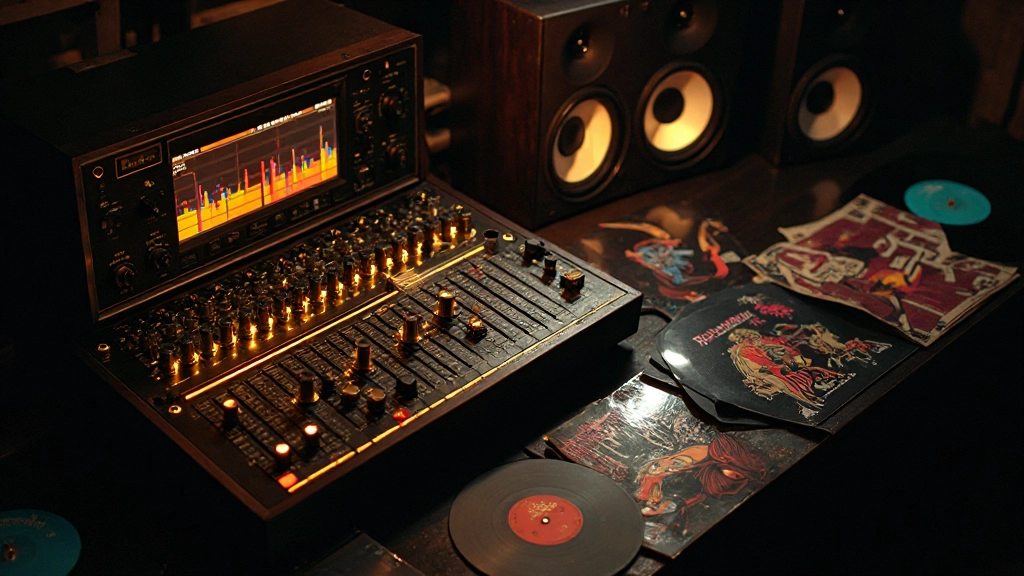
It was 2:47 AM when Jerome finally understood why his mixes sounded so different from the records that inspired him. He'd been staring at the same rock ballad for six hours, tweaking EQ curves and adjusting levels, but something fundamental was missing. The breakthrough came when he loaded his favorite Radiohead track alongside his own mix and started really listening to the frequency balance.
That moment of comparison changed everything. Jerome discovered what mixing engineers have known for decades: your ears need a North Star, and reference tracks provide that crucial navigational tool for EQ decisions that make or break a mix.
Why Your EQ Choices Need a Reality Check
Most home studio engineers approach EQ like they're painting in a dark room. They boost here, cut there, and hope for the best. But without a reference point, you're essentially guessing what "professional" should sound like in your specific listening environment.
Reference track EQ matching isn't about copying another song note for note. It's about understanding the frequency relationships that make professional recordings translate across different playback systems. When Jerome started using references systematically, his mixes immediately gained the clarity and balance that had been eluding him for years.
The Art of Strategic Reference Selection
Not every great song makes a good reference track. Jerome learned this the hard way when he tried matching his indie rock mix against a heavily compressed pop track from the late 90s. The frequency signatures were so different that his mix ended up sounding worse, not better.
Effective reference selection follows specific criteria. First, choose tracks in a similar genre and energy level to your own material. A whisper-quiet folk ballad won't help you balance a driving rock anthem. Second, pick songs with similar instrumentation. If your track features acoustic guitar, piano, and vocals, don't reference against a track dominated by synthesizers and programmed drums.
Third, and this surprised Jerome initially, select references that were mastered in the last five to ten years. Older classics might sound amazing, but their frequency balance often reflects different mastering standards that won't translate to modern streaming platforms and playback systems.
| Reference Selection Criteria | Why It Matters | Common Mistakes |
|---|---|---|
| Similar Genre/Energy | Frequency expectations vary by style | Using pop references for metal mixes |
| Comparable Instrumentation | Each instrument occupies specific frequency ranges | Referencing synth-heavy tracks for organic recordings |
| Contemporary Mastering | Modern loudness and frequency standards | Using 1970s recordings as templates |
| Professional Production | Proven translation across systems | Referencing bedroom recordings or demos |
Loading References Into Your Workflow
Jerome's initial approach was clunky. He'd play his mix, then switch to iTunes to hear his reference, trying to remember the frequency differences between playbacks. This method was not only inefficient but also unreliable, since audio memory fades quickly and playback levels varied between sources.
The solution was integrating reference tracks directly into his DAW session. Most modern DAWs allow you to import reference audio onto dedicated tracks. Set these tracks to bypass all processing, route them directly to your main outputs, and level-match them to your mix using a gain plugin. This setup enables instant A/B comparisons without leaving your mix environment.
Level matching is crucial here. If your reference track is significantly louder than your mix, you'll be tempted to make EQ decisions based on volume differences rather than frequency balance. Use a VU meter or loudness meter to match perceived levels, typically aiming for similar RMS or LUFS readings.
- Import your reference track on a dedicated channel
- Insert a gain plugin and adjust to match your mix's perceived loudness
- Route the reference directly to your main outputs, bypassing all mix bus processing
- Color-code the reference track distinctly for quick visual identification
- Set up key commands for instant muting/soloing of reference tracks
Training Your Ears Through Active Analysis
Simply having reference tracks loaded isn't enough. Jerome discovered that effective EQ matching requires active, focused listening sessions dedicated to understanding frequency relationships. This means temporarily stepping away from creative mixing decisions and adopting an analytical mindset.
Start by listening to your reference track through different frequency ranges. Solo the low end using a high-pass filter at 200Hz, then gradually sweep the filter frequency up while noting how the reference track's energy distribution changes. Pay attention to where the bass fundamentals sit, how much sub-bass content exists, and where the low-mid warmth lives.
Repeat this process with your own mix. The differences will often be immediately obvious. Maybe your bass guitar has too much 80Hz content compared to the reference, or perhaps your kick drum lacks the punch that sits around 60Hz in professional mixes.
"The magic happens when you stop mixing and start listening. References teach you what balanced actually sounds like in your room."
Frequency Band Surgery
Once Jerome could hear the differences between his mixes and his references, he needed a systematic approach to address them. Random EQ adjustments wouldn't cut it. He developed a frequency band methodology that tackled the spectrum in logical sections.
Start with the low end: 20-250Hz. This range contains the fundamental power of your mix. Reference tracks in most genres maintain careful balance here, with enough bass presence to feel powerful without overwhelming the mix. Compare how your reference handles kick drum fundamentals versus bass guitar fundamentals. Notice whether there's clear separation or strategic overlap.
Move to the low-mids: 250-800Hz. This is where mixes either sound warm and full or muddy and congested. Professional mixes often have less energy here than amateur productions. Jerome found that cutting 2-3dB in this range, guided by reference comparisons, immediately cleaned up his mixes without losing warmth.
The critical mid-range spans 800Hz-3kHz, containing the presence and definition that makes elements cut through the mix. Reference tracks typically show careful balance here, with vocals sitting prominently but not harshly, and instruments maintaining clarity without competing destructively.
Real-Time Reference Switching
Jerome's workflow evolved to include real-time reference switching during EQ adjustments. Rather than making changes and then checking references, he learned to toggle between his mix and references while actively adjusting EQ parameters. This immediate feedback loop accelerated his learning and improved his decision-making accuracy.
Set up your reference switching to be instantaneous. Many engineers use dedicated monitor controllers or DAW key commands that allow seamless switching. The goal is eliminating any delay between hearing your mix and hearing your reference, since even a few seconds can disrupt the comparative listening process.
When adjusting EQ, make a change to your mix, immediately switch to your reference for 10-15 seconds, then switch back. This rapid A/B process reveals whether your adjustment moved you closer to or further from the frequency balance you're targeting.
- Set up instant reference switching via key commands
- Level-match references to your mix's loudness
- Use multiple references to avoid fixating on one frequency signature
- Take breaks between comparison sessions to reset your ears
- Document successful EQ moves for future reference
Beyond Frequency: Learning Musical Balance
As Jerome's reference-based EQ skills developed, he realized the technique taught him more than just frequency balance. References revealed how professional mixes handle musical priorities. Which elements sit upfront? What gets pushed back? How do different frequency ranges support the song's emotional arc?
In ballads, references often showed restrained low-end until choruses, when bass presence increased to support emotional lift. Rock tracks demonstrated how guitar distortion could occupy midrange space without competing with vocal clarity. Electronic music references revealed how synthesizer fundamentals could coexist with live bass guitar through careful frequency slot allocation.
These musical insights transformed Jerome's mixing approach from technical problem-solving to artistic decision-making informed by proven reference points. His mixes gained not just better frequency balance, but better musicality.
Building Your Reference Library
Jerome eventually assembled a curated library of reference tracks organized by genre, energy level, and instrumentation. This wasn't a massive collection, but rather a focused set of 20-30 tracks that consistently demonstrated excellent frequency balance and translation across different playback systems.
He tested potential references on multiple speaker systems, in his car, and through headphones. Only tracks that maintained their frequency balance and musicality across all these environments earned spots in his reference library. This quality control ensured that his EQ decisions would translate reliably to the real world.
The library became his secret weapon. Whether mixing indie rock, acoustic folk, or electronic music, Jerome had proven frequency templates to guide his EQ decisions. His mixes transformed from good-sounding recordings to professional productions that translated consistently across different playback environments.
Reference track EQ matching isn't about sacrificing creativity for conformity. Instead, it's about understanding the frequency relationships that allow your creative vision to translate effectively to your audience. In Jerome's words, "References didn't limit my creativity; they gave my creativity a professional foundation to build upon."
Hear what these choices do to your own song.
Upload stems or a finished track, choose a reference direction, and compare a private Moozix mix before you export anything.